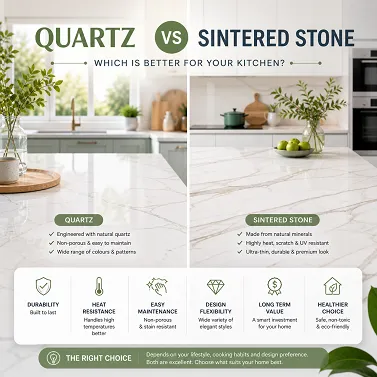
Choosing the right countertop isn’t just about looks—it affects durability, maintenance, and long-term value.
Two of the most popular options today are quartz and sintered stone. They may look similar at first glance, but they behave very differently in real use.
This guide breaks it down so you can choose the right one for your home.
🧱 1. What Is Quartz?

Quartz countertops are engineered surfaces made from:
- Natural quartz particles
- Resin binders
- Pigments
👉 This makes them:
- Non-porous
- Consistent in design
- Widely available
🔥 2. What Is Sintered Stone?

Sintered stone is made using:
- Natural minerals (like stone, clay, silica)
- Compressed under extreme heat and pressure
👉 The result:
- Ultra-dense surface
- No resin content
- Highly resistant to heat and scratches
⚖️ 3. Key Differences at a Glance
| Feature | Quartz | Sintered Stone |
|---|---|---|
| Composition | Quartz + resin | Natural minerals (no resin) |
| Heat resistance | Moderate | Very high |
| Scratch resistance | Good | Excellent |
| UV resistance | Can fade | UV-proof |
| Thickness options | Standard | Ultra-thin possible |
| Cost | Moderate | Higher |
🔥 4. Heat Resistance (Major Difference)

This is where sintered stone clearly wins.
Quartz:
- Contains resin
- Can be damaged by high heat
- Hot pots may cause discoloration
Sintered Stone:
- No resin
- Can withstand very high temperatures
- Safe for hot cookware
👉 If you cook often, this matters.
🧼 5. Maintenance & Cleaning

Both materials are relatively easy to maintain.
Quartz:
- Non-porous
- Easy to clean
- Avoid harsh chemicals
Sintered Stone:
- Also non-porous
- More resistant to stains and chemicals
👉 Both are low-maintenance, but sintered stone is more robust.
💎 6. Design & Aesthetic

Quartz:
- Consistent patterns
- Wide range of colours
- More uniform look
Sintered Stone:
- More natural stone-like patterns
- Large slab designs (fewer joints)
- More premium visual depth
👉 Sintered stone often looks more “luxury”
💰 7. Cost Comparison
- Quartz → More affordable
- Sintered stone → Premium pricing
👉 Cost depends on:
- Brand
- Thickness
- Installation complexity
🏠 8. Which Should You Choose?
Choose Quartz if you:
- Want a more affordable option
- Prefer consistent design
- Don’t place hot items directly
Choose Sintered Stone if you:
- Want maximum durability
- Cook frequently
- Prefer a premium, natural look
⚠️ 9. Common Mistakes to Avoid
- Choosing based on looks only
- Ignoring heat resistance
- Not asking about thickness and installation
- Assuming all “stone” surfaces are the same
🧠 10. How This Affects Your Carpentry
Your countertop choice impacts:
- Cabinet support structure
- Installation method
- Long-term durability
👉 For more on build quality, read:
How Custom Carpentry Is Made (Workshop Process)
🏁 Final Thoughts
Both quartz and sintered stone are excellent materials—but they serve different needs.
👉 The right choice depends on:
- How you use your kitchen
- Your budget
- Your expectations for durability