
Custom carpentry is a key component of most home renovations in Singapore. From wardrobes and kitchen cabinets to TV consoles and storage systems, carpentry not only defines aesthetics but also affects durability and daily usability.
However, carpentry quotations often vary widely, leaving homeowners confused about pricing differences and material choices. This guide explains carpentry cost in Singapore, how pricing is calculated, the differences between plywood and engineered particleboard, and why Milanla carpentry focuses on long-term value.
How Carpentry Cost Is Calculated in Singapore
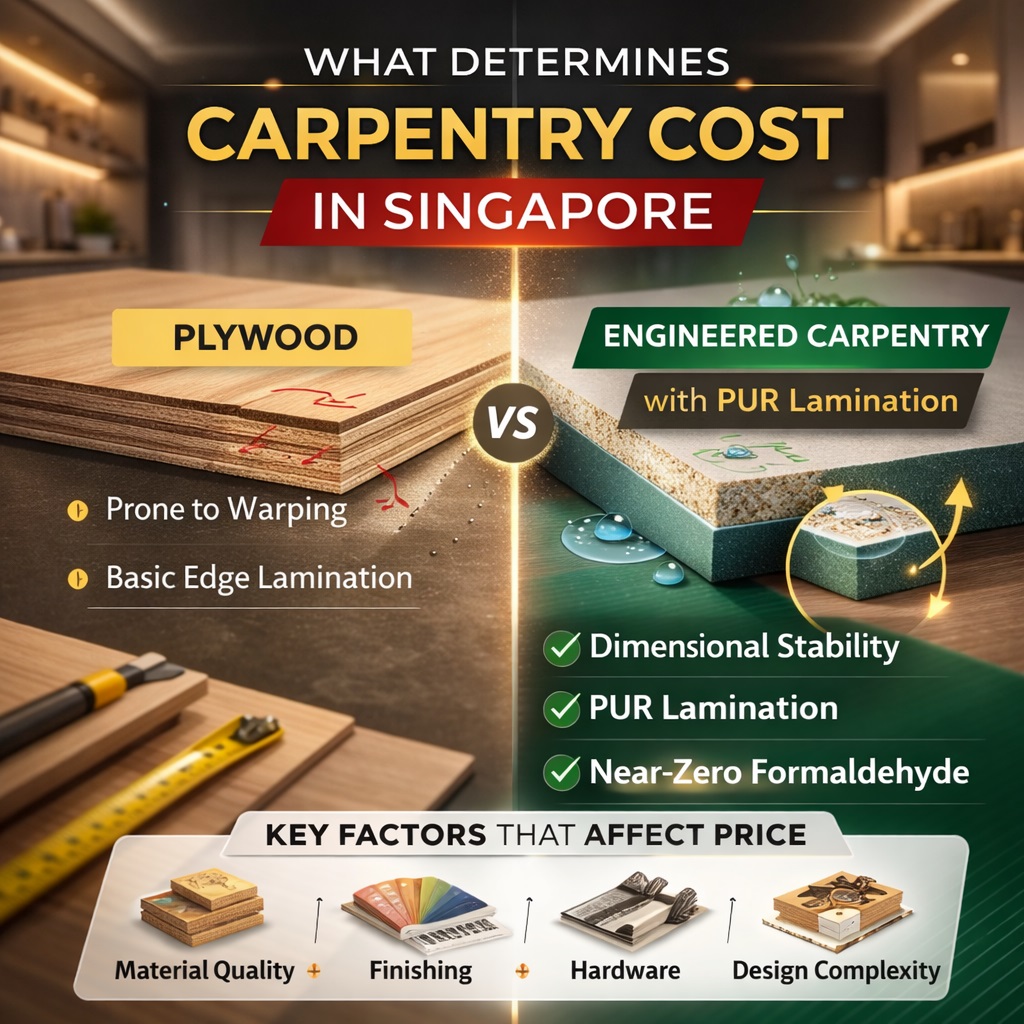
Carpentry pricing is typically based on per foot run (ft run) for built-in cabinets and wardrobes, with pricing influenced by:
- Material type
- Finishing selection
- Hardware and accessories
- Design complexity
- Fabrication and installation standards
While many homeowners assume material type alone determines price, the overall carpentry system — including edging technology and fabrication precision — plays an equally important role.
For overall renovation budgeting, see our Home Renovation Cost in Singapore Guide.
Traditional Carpentry in Singapore: Plywood-Based Cabinets
Most local carpenters traditionally use plywood as the base material due to its structural strength and familiarity in fabrication. Plywood carpentry offers:
- Strong screw-holding capability
- Good load-bearing strength
- Established reputation for durability
However, plywood carpentry may also present some limitations:
- Natural wood layers can move or warp over time
- Surface finishing may be less uniform
- Quality can vary depending on plywood grade and source
- Moisture resistance depends heavily on edging quality
Modern Carpentry: Engineered Particleboard
Advancements in board manufacturing have significantly improved particleboard performance. Milanla uses engineered particleboard, which offers:
- Consistent density and structure
- Improved dimensional stability
- Smoother surface for laminate finishing
- Reduced risk of uneven warping compared to layered plywood
Modern engineered particleboard is very different from the lower-quality boards commonly associated with older carpentry methods.
Why PUR Edge Banding Makes a Difference
The real performance difference in modern carpentry lies in edge banding technology.
Traditional carpentry often uses EVA lamination, while Milanla uses PUR edging, which provides:
| Feature | EVA Lamination | PUR Lamination |
|---|---|---|
| Water resistance | Moderate | Very high |
| Heat resistance | Moderate | High |
| Adhesion strength | Standard | Superior |
| Edge durability | Lower | Stronger |
PUR bonding forms a tighter seal, significantly improving moisture resistance — particularly important for kitchens and wardrobes in Singapore’s humid environment.
Milanla Carpentry Pricing Guide (2026)
At Milanla, carpentry pricing reflects finishing quality, hardware accessories, and fabrication standards rather than charging drastically different rates for each carpentry type.
For most custom carpentry items such as wardrobes, kitchen cabinets, TV consoles, and storage units, Milanla’s pricing typically ranges between:
👉 $320 – $450 per foot run (full-height 2.6m carpentry)
What Influences the Final Price
1. Finishing Selection
Different laminates and finishes affect pricing, including:
- Standard laminates
- Premium textured or anti-fingerprint finishes
- Fluted panels or glass accents
These upgrades enhance durability and aesthetics.
2. Internal Accessories and Hardware
Pricing may increase depending on built-in features such as:
- Soft-close hinges and runners
- Pull-out storage systems
- Integrated lighting
- Glass shelving and display compartments
These accessories significantly improve functionality and daily usability.
3. Design Complexity
Design elements such as feature panels, curved carpentry, or integrated lighting can increase fabrication complexity and cost.
Why Milanla Pricing Is Consistent Across Carpentry Types
Unlike quotations that vary widely across wardrobes, cabinets, and consoles, Milanla maintains similar pricing because:
- The same engineered board system is used throughout
- PUR edging technology is consistently applied
- Hardware quality remains standardised
- Fabrication and finishing processes follow strict quality control
This ensures homeowners receive uniform quality across the entire home.
Why Slightly Higher Carpentry Pricing Can Mean Better Value
While Milanla carpentry may cost slightly more than budget carpentry, homeowners benefit from:
- Improved dimensional stability
- Stronger moisture resistance
- Cleaner finishing and alignment
- Healthier near-zero formaldehyde materials
- Longer lifespan and reduced maintenance
Rather than focusing solely on upfront price, Milanla emphasises overall carpentry system quality.
Tips for Comparing Carpentry Quotations
When reviewing carpentry quotes, homeowners should ask:
- What board material is used?
- Is PUR or EVA edging applied?
- What hardware brand is included?
- Where is fabrication done?
- What warranty is provided?
These factors often matter more than plywood vs particleboard alone.
Conclusion
Carpentry cost in Singapore depends on more than material type — fabrication precision, edging technology, hardware quality, and finishing all contribute to long-term durability and usability. While plywood remains widely used, engineered particleboard with PUR edging offers a stable, moisture-resistant, and refined alternative that delivers excellent value.
If you are considering custom carpentry for your home, understanding these material and pricing differences helps you make a more informed decision.
👉 Request a Milanla carpentry consultation here: Contact