
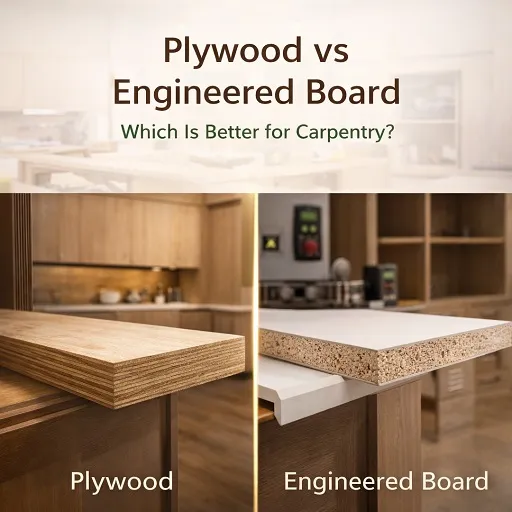
When planning custom carpentry, one of the most common questions homeowners ask is:
Should I choose plywood or engineered boards like particle board?
Traditionally, plywood has been seen as the “better” option. However, with modern manufacturing and fabrication techniques, this is no longer always true.
👉 In fact, for most homes today, engineered boards such as particle board can perform just as well—when properly fabricated and installed.
What Is Plywood?

Plywood is made by layering thin sheets of wood veneer in alternating grain directions.
Key Characteristics:
- Strong structural integrity
- Naturally more moisture-resistant
- Holds screws well
- Traditional carpentry material
👉 It is commonly used where extra durability or moisture resistance is required.
What Are Engineered Boards?

Engineered boards include:
- Particle board
- MDF
- Other compressed wood-based panels
They are manufactured by bonding wood particles or fibres under pressure.
Key Characteristics:
- Smooth and uniform surface
- Consistent quality (no warping or natural defects)
- Works very well with laminates
- Cost-efficient
👉 These are widely used in modern built-in carpentry systems today.
⚖️ The Truth: Is Particle Board as Good as Plywood?
👉 Yes — in most residential applications, it performs just as well.
When properly fabricated:
- Laminates protect the surface
- Internal environments are dry and controlled
- Cabinets are not under heavy structural stress
👉 In real-world usage, most homeowners will not notice a difference in performance.
💧 Can Particle Board Be Used for Kitchens?
This is one of the biggest concerns for homeowners.
👉 Yes — it can be used for kitchens when properly constructed.
Modern carpentry combines:
- High-pressure laminate surfaces
- PUR edge banding (a key upgrade over standard glue)
- Proper sealing during installation
🔒 Why PUR Edge Banding Matters
PUR (Polyurethane Reactive) edge banding:
- Creates a strong, tight seal at panel edges
- Significantly improves moisture resistance
- Reduces the risk of water penetration
👉 This is a major factor in ensuring long-term durability.
⚠️ Important Consideration
While highly moisture-resistant:
👉 Engineered boards are not fully waterproof
So for areas with direct and frequent water exposure (e.g. under the sink):
- Additional protection is applied
- Or suitable materials are recommended
👉 In most kitchen areas, however:
Particle board with proper fabrication performs reliably and effectively
🛠️ Where Each Material Works Best
🟢 Engineered Board (Recommended for Most Uses)
- Wardrobes
- TV consoles
- Kitchen cabinets (general areas)
- Feature walls
Milanla’s under sink cabinet interior is lined with aluminum to insulate the board from any moisture for maximum durability.

👉 For design inspiration, explore our Walk-In Wardrobe Design Guide.
🟡 Plywood (Used Selectively)
- Bathrooms
- High moisture zones
👉 For storage planning, see Wardrobe Interior Storage Ideas.
💰 Cost vs Practical Value
Engineered Board
- More cost-efficient
- Consistent quality
- Ideal for most residential applications
Plywood
- Higher cost
- Better for niche use cases
👉 For pricing insights, refer to our Kitchen Cabinet Cost Guide in Singapore.
🧠 What Really Determines Quality
Material alone does not determine durability.
👉 The most important factors are:
- Fabrication method
- Edge sealing (e.g. PUR edge banding)
- Installation quality
- Design planning
👉 To understand the full process, read How Custom Carpentry Is Made (Workshop Process).
🔍 Common Misconception
❌ “Plywood is always better”
👉 This is outdated.
Modern engineered boards:
- Are more stable
- Provide better finishing
- Are widely used in today’s carpentry
🏁 Final Verdict
🥇 Choose Engineered Board if you want:
- Cost efficiency
- Clean, modern finishes
- Reliable performance for most home use
🥈 Choose Plywood if:
- There is direct water exposure
- Extra structural strength is required
💡 Final Thoughts
The right material isn’t about which is “stronger”—it’s about what is appropriate for your usage and environment.
👉 With modern techniques like PUR edge banding, engineered boards have become:
A highly reliable and practical choice for most homes in Singapore
🔗 Related Articles
- Walk-In Wardrobe Design Guide
- Wardrobe Interior Storage Ideas
- Kitchen Cabinet Cost Guide in Singapore
- How Custom Carpentry Is Made (Workshop Process)