
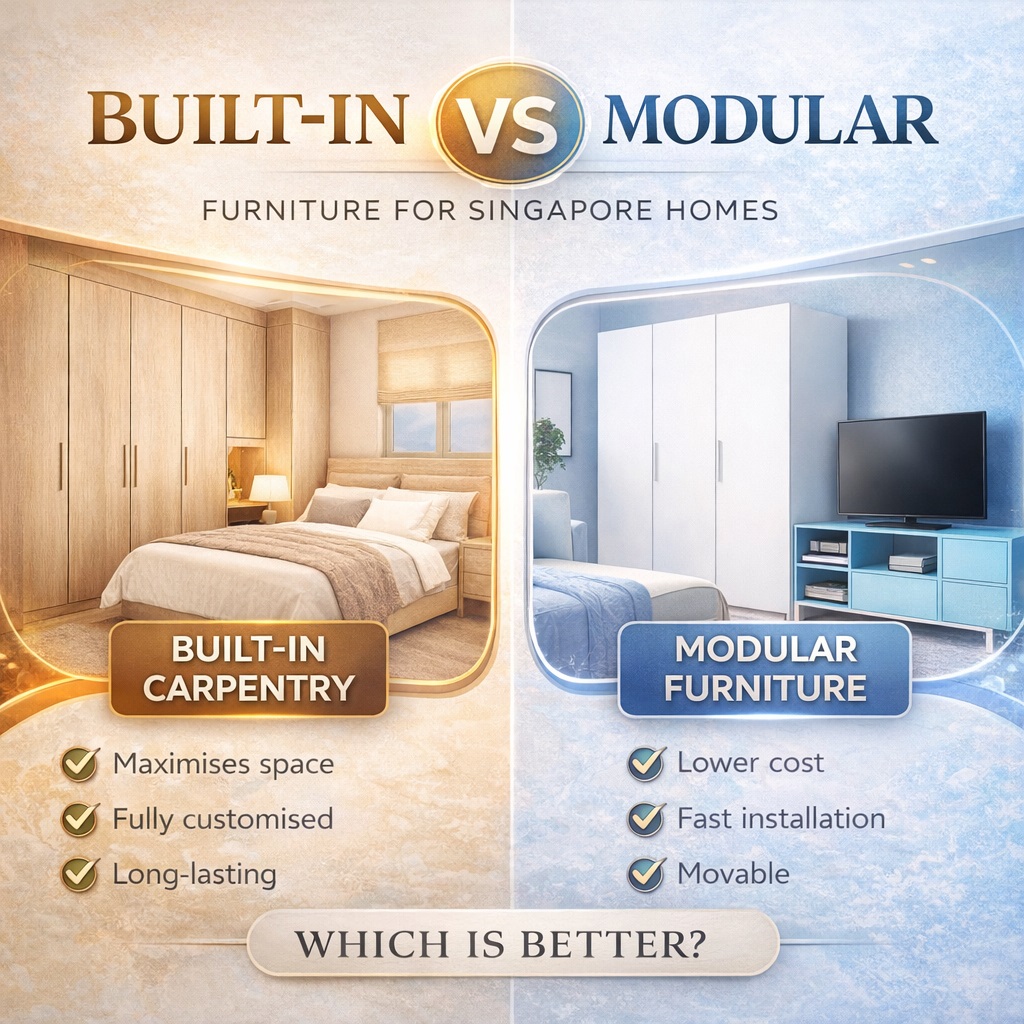
When furnishing or renovating a home in Singapore, homeowners often face an important decision: should you choose built-in carpentry or modular furniture?
Both options offer advantages depending on your needs, budget, and lifestyle. Understanding the differences can help you choose the best solution for your space.
This guide explains the pros and cons of built-in and modular furniture for Singapore homes.
What Is Built-In Furniture?
Built-in furniture refers to custom carpentry designed specifically for your home’s layout and dimensions.
Common built-in carpentry includes:
- Wardrobes
- Kitchen cabinets
- TV consoles
- Shoe cabinets
- Study tables
- Storage systems
Built-in furniture is fabricated according to precise measurements, allowing it to integrate seamlessly into your home.
You can learn more in our Custom Wardrobe Design Guide Singapore.
Advantages of Built-In Furniture
1. Maximises Space Efficiency
Built-in carpentry uses floor-to-ceiling storage, making it ideal for Singapore homes where space is limited.
It allows homeowners to utilise:
- Awkward corners
- Narrow spaces
- Full wall height
This is particularly beneficial for BTO flats and condominiums.
2. Fully Customised Design
Built-in furniture can be tailored to match your interior design style.
Homeowners can customise:
- Materials and laminates
- Storage layouts
- Colours and textures
- Lighting integration
This creates a cohesive and polished interior appearance.
3. Better Long-Term Durability
Quality built-in carpentry uses:
- Engineered boards or plywood
- Durable hardware systems
- Precision fabrication
This ensures cabinets remain aligned and functional over time.
You can read more in our Carpentry Cost Singapore Guide.
Disadvantages of Built-In Furniture
1. Higher Initial Cost
Custom carpentry typically costs more than modular furniture because it involves:
- Custom fabrication
- Professional installation
- Higher material costs
However, it often provides better long-term value.
2. Permanent Installation
Built-in furniture is fixed and cannot easily be moved or relocated.
This may not suit homeowners who plan to move frequently.
What Is Modular Furniture?
Modular furniture refers to ready-made furniture systems that can be assembled and rearranged easily.
Examples include:
- IKEA wardrobes
- Modular shelving units
- Ready-made cabinets
- Flat-pack furniture systems
These are usually mass-produced and available for quick installation.
Advantages of Modular Furniture
1. Lower Upfront Cost
Because modular furniture is mass-produced, it is generally cheaper than custom carpentry.
This makes it appealing for homeowners with limited budgets.
2. Faster Installation
Modular furniture can be assembled quickly, often within hours or days.
This makes it convenient for homeowners who need immediate furnishing.
3. Flexible and Moveable
Unlike built-in furniture, modular pieces can be:
- Rearranged
- Replaced
- Moved when relocating
Disadvantages of Modular Furniture
1. Limited Customisation
Modular furniture is designed with standard dimensions, which may not fit every space perfectly.
This can result in unused gaps or inefficient storage.
2. Lower Durability
Mass-produced furniture often uses lighter materials that may not last as long as built-in carpentry.
Frequent assembly and disassembly can also weaken structural components.
Built-In vs Modular Furniture Comparison
| Feature | Built-In Carpentry | Modular Furniture |
|---|---|---|
| Customisation | Fully customised | Limited |
| Space optimisation | Excellent | Moderate |
| Durability | High | Moderate |
| Installation time | Longer | Faster |
| Flexibility | Fixed | Movable |
For many Singapore homes, built-in carpentry offers better space utilisation and long-term value.
Built-In Carpentry Cost in Singapore
Custom carpentry pricing varies depending on design complexity, finishing, and accessories.
At Milanla, built-in carpentry typically ranges between:
👉 $320 – $450 per foot run for full-height carpentry (2.6m)
This includes:
- Engineered particleboard
- PUR edge banding
- Quality hinges and hardware
- Precision fabrication and installation
When Should You Choose Built-In Furniture?
Built-in carpentry is ideal when you want:
- Maximum storage efficiency
- Seamless interior design
- Long-lasting furniture
- Customised layouts
When Modular Furniture May Be Better
Modular furniture may be suitable if you:
- Need temporary furnishing
- Have a tight renovation budget
- Prefer movable furniture
- Plan to relocate frequently
Conclusion
Both built-in carpentry and modular furniture have their place in Singapore homes. While modular furniture offers flexibility and lower upfront cost, built-in carpentry provides superior space optimisation, durability, and design customisation.
Understanding these differences helps homeowners make better renovation decisions and create more functional living spaces.
👉 Request a carpentry consultation here: Contact