
Choosing the right kitchen cabinet material is one of the most important decisions in any kitchen renovation. Cabinet materials affect durability, moisture resistance, finishing quality, and long-term maintenance — all critical factors in Singapore’s humid climate.
This guide explains the most common kitchen cabinet materials used in Singapore and how to choose the best option for your home.
Why Kitchen Cabinet Material Matters
Kitchen cabinets are exposed to:
- Heat from cooking
- Moisture and humidity
- Daily wear and tear
- Cleaning chemicals
Selecting the right material ensures cabinets remain durable, functional, and visually appealing over time.
For renovation budgeting, see our Kitchen Renovation Cost Guide.
Common Kitchen Cabinet Materials in Singapore
1. Plywood
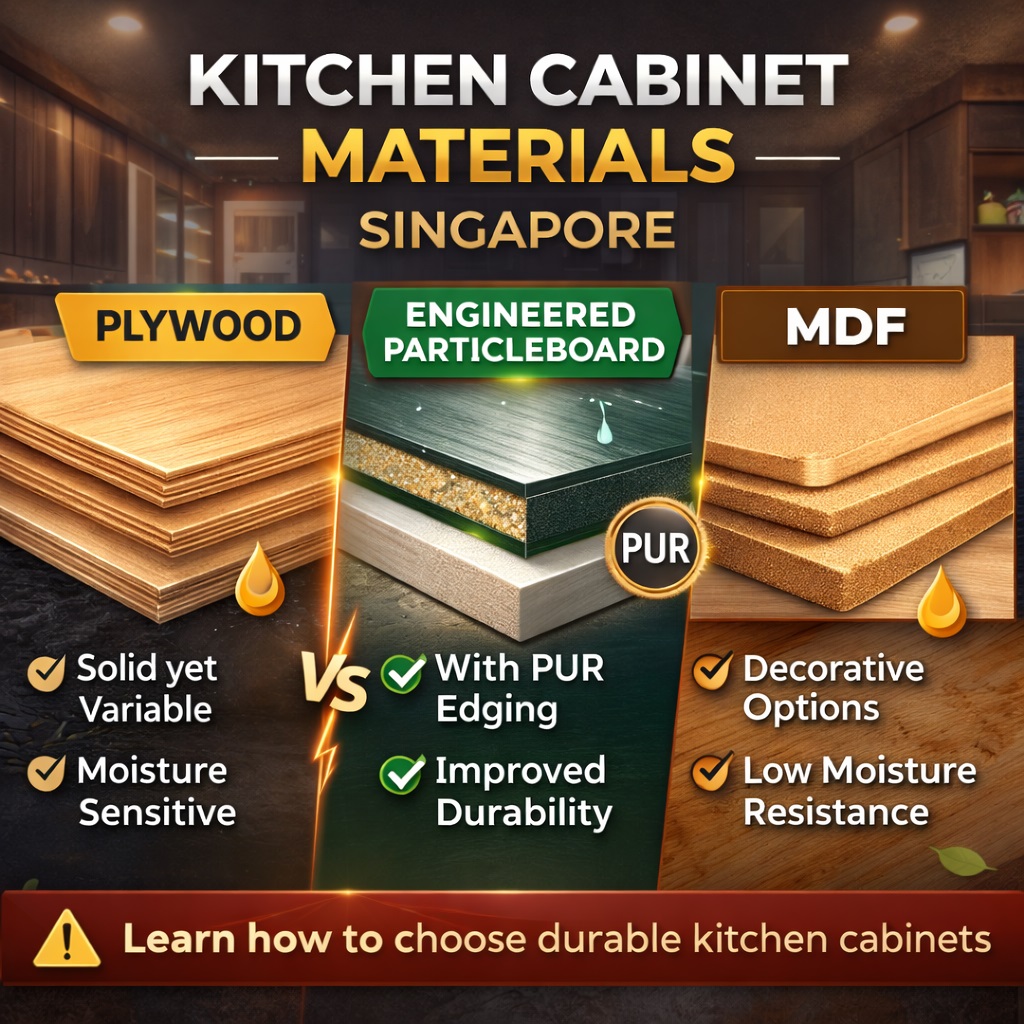
Plywood has traditionally been the preferred carpentry material due to its layered wood construction.
Advantages
- Strong screw-holding strength
- Good structural stability
- Widely used and familiar fabrication
Considerations
- Quality varies by grade
- Surface finishing may be less uniform
- Moisture resistance depends heavily on edging
2. Engineered Particleboard
Modern engineered particleboard has gained popularity due to improved manufacturing quality and consistent structure.
Advantages
- Smooth surface for laminate finishing
- Consistent density and thickness
- Reduced risk of uneven warping
- Cost-efficient compared to plywood
When paired with advanced edging technology, engineered particleboard can achieve strong durability.
3. MDF (Medium-Density Fibreboard)
MDF is sometimes used for specific cabinet components or decorative panels.
Advantages
- Smooth surface for painting or laminating
- Easy to shape for decorative detailing
Considerations
- Lower moisture resistance
- Less commonly used for full kitchen cabinetry
Why Edge Banding Is More Important Than Material Alone
Many homeowners focus solely on board material, but cabinet durability often depends on edge banding technology.
Traditional EVA edging provides moderate sealing, while modern PUR edging offers:
- Stronger adhesive bonding
- Better moisture resistance
- Higher heat resistance
- Improved laminate durability
This is especially important for kitchens where exposure to moisture is frequent.
Milanla Kitchen Cabinet Material Approach
At Milanla, we use engineered particleboard with PUR edging to deliver a balanced combination of durability, finishing precision, and moisture resistance.
Key Benefits
- Stable cabinet alignment and finishing
- Improved moisture protection
- Cleaner laminate adhesion
- Healthier near-zero formaldehyde boards
- Consistent fabrication quality
This system ensures long-term cabinet performance without relying solely on plywood.
You can learn more about carpentry pricing in our Carpentry Cost Singapore Guide.
Choosing the Right Kitchen Cabinet Material
When selecting cabinet materials, consider:
- Moisture exposure level
- Design and finishing preference
- Budget range
- Hardware quality
- Fabrication precision
Rather than focusing only on plywood vs particleboard, homeowners should evaluate the overall carpentry system.
Tips for Long-Lasting Kitchen Cabinets
- Use high-quality hinges and runners
- Avoid prolonged water exposure on cabinet edges
- Choose durable laminate finishes
- Ensure proper installation alignment
- Work with experienced carpentry specialists
Proper material and fabrication choices significantly extend cabinet lifespan.
Conclusion
Kitchen cabinet material selection plays a major role in renovation quality and long-term durability. While plywood remains widely used, modern engineered particleboard combined with PUR edging offers a stable, moisture-resistant, and refined alternative suitable for Singapore homes.
Understanding these material differences helps homeowners make informed decisions and achieve better renovation outcomes.
👉 Request a kitchen carpentry consultation here: Contact